Our countries


Europe
 Austria | Österreich
 Belgium | BelgiqueBelgium | België
 Bulgaria | България
 Croatia | Hrvatska
 Czechia | Česko
 Denmark | Danmark
 Estonia | Eesti
 Finland | Suomi
 France
 Germany | Deutschland
 Hungary | Magyarország
 Ireland | Éire
 Italy | Italia
 Latvia | Latvija
 Lithuania | Lietuva
 Netherlands | Nederland
 Norway | Norge
 Poland | Polska
 Portugal
 Romania | România
 Slovakia | Slovensko
 Slovenia | Slovenija
 Spain | España
 Sweden | Sverige
 Switzerland | SchweizSwitzerland | Suisse
 Turkey | Türkiye
 United Kingdom
Search
How Roof Tiles Protect Your Home from Heavy Rain in Malaysia
Share:
The Role of Roof Tiles in Protecting Your Home from Heavy Rain
Malaysia receives between 2,000 and 4,000 mm of rainfall annually, according to . During peak monsoon periods, rainfall intensity can exceed 80 mm per hour. That is not light rain testing your roof. That is a serious load, and what happens to it depends on how your tiles are designed.
This article explains how roof tiles manage heavy rain, what design features determine water resistance, and why some materials fail at the overlap while others do not.
How Do Roof Tiles Manage Heavy Rain?
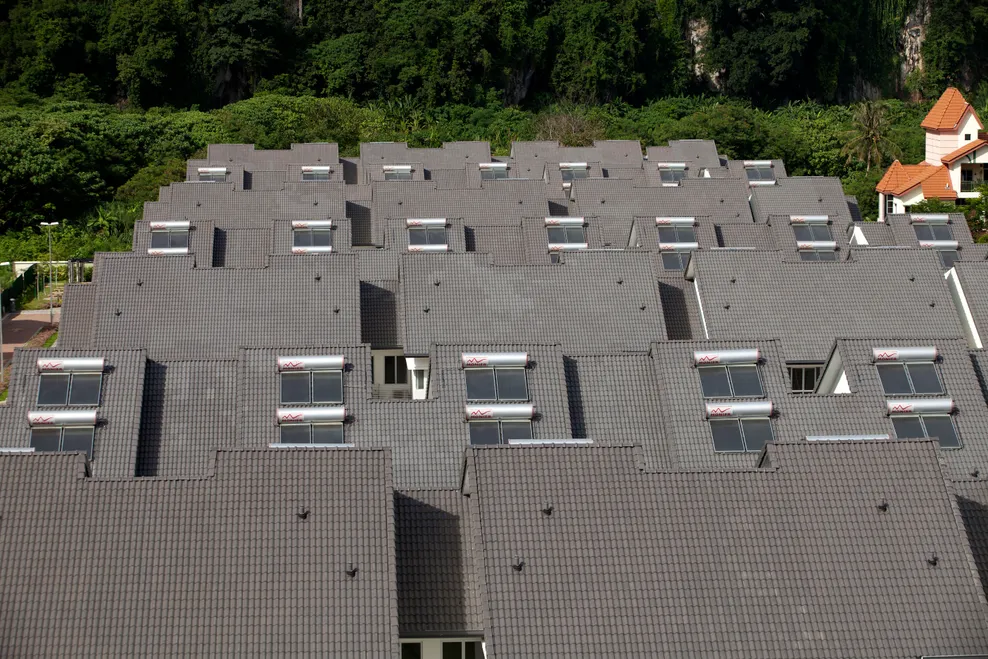
Roof tiles protect your home from heavy rain through a combination of surface drainage, tile geometry, and interlocking design. Water lands on the tile surface, runs along the profile channels, passes over the tile-to-tile joint, and continues down to the gutters.
The critical point in this system is the joint between tiles. How that joint is designed determines whether water stays on the roof surface or finds a path into the structure below.
Interlocking Tiles vs Overlapping Sheets: The Key Difference
MONIER® concrete and clay tiles use an interlocking system. Each tile connects to the tiles around it through a precision-formed profile that channels water in a defined direction. There are no sealant-dependent joints. Water follows the geometry of the tile, not the integrity of an applied adhesive.
Metal sheet roofing works differently. Sheets overlap at their edges and the overlap joint is sealed, either mechanically or with sealant. The seal keeps water out when it is new and intact. Over time, in Malaysia's combination of heat, UV, and monsoonal rain, sealant joints degrade. When they go, water enters at the overlap. This is the most common complaint on older metal roofs in Malaysia.
MONIER® concrete tiles carry a low water leakage risk with proper installation. MONIER® clay tiles are naturally waterproof and carry the same low risk. Standard and premium metal both carry a moderate water leakage risk because their overlaps can leak if not sealed properly.
Why Installation Quality Matters as Much as Tile Design
Even the best tile system leaks if it is installed incorrectly. Incorrect batten spacing causes tiles to sit out of alignment, disrupting the drainage path. Missing fixings allow tiles to shift in high wind, opening gaps. Incorrect underlay installation means water that does penetrate the tile layer has nowhere to go but down through the ceiling.
A RoofPro-certified MONIER® installer follows a defined system specification that covers batten spacing, underlay type and installation method, tile fixing requirements, and ridge and hip capping details. This specification is not optional. It is what the system's performance rating is based on.
Homeowners who use a RoofPro installer are eligible to receive the MONIER® Roof System Guarantee, which covers the performance of the installed system. An uncertified contractor provides none of that assurance.
What Happens Under the Tiles: The Role of Underlay
Underlay is the water-resistant layer installed directly under the tiles and over the battens. It is the secondary line of defence when a tile is dislodged, cracked, or temporarily allows water through during extreme rainfall.
A compromised underlay is invisible from outside the home. It only becomes apparent when water stains appear on the ceiling. By that point, the underlay has usually been failing for some time and the timber structure may have been exposed to moisture for longer than is acceptable.
During a BumbungCare roof audit, the condition of the underlay is assessed as part of the inspection. Many Malaysian homeowners discover underlay failure during this process, well before visible ceiling damage appears.
Sound During Rain: What Heavy Rainfall Sounds Like From Inside
Tiles’ natural density acts as built-in acoustic insulation, helping to dampen the sound of rain without the need for additional layers. This makes tile roofing a reliable choice in tropical climates, where frequent rainfall is part of daily life.
In contrast, metal roofs can produce between 50-65 dB of noise during rainfall when installed without insulation, often requiring added acoustic treatment to achieve similar comfort levels. With tile roofing, the material’s inherent thermal mass helps regulate both sound and temperature, providing consistent acoustic comfort throughout the roof’s lifespan without relying on insulation that may deteriorate over time.
Talk to MONIER® Before the Next Monsoon
If your roof is leaking, if you can hear every raindrop, or if you are planning to renovate before the next monsoon season, a BumbungCare roof audit is the best starting point. A trained MONIER® advisor will assess your roof's condition, identify where the system is vulnerable, and recommend the right solution.
Call 1800 88 0865 or visit BMI Group Website to book your free consultation. You can also visit the Experience Centre in Bukit Kemuning to see MONIER® tile systems in person.
Frequently Asked Questions
Which roof tiles are best for heavy rain in Malaysia?
MONIER® concrete and clay tiles are best suited for Malaysia's heavy rainfall. Both use interlocking designs with no sealant-dependent overlap joints, giving them a low water leakage risk with proper installation. Metal sheet roofing relies on sealed overlaps that can degrade over time and carries a moderate leakage risk.
Why does my roof leak only during heavy rain?
Leaks that appear only during heavy rain usually indicate a compromised sealant joint, missing or shifted tiles, or a degraded underlay. Light rain may not generate enough volume or pressure to find the weakness. A BumbungCare roof audit will identify the source of the problem accurately.
What is the role of underlay in preventing roof leaks?
Underlay is the secondary waterproof barrier installed under the tiles and over the battens. When a tile is cracked, shifted, or temporarily allows water through, the underlay prevents that water from reaching the timber structure and ceiling below. A failed underlay means the structural timbers are exposed to moisture with no protection.
Does rain noise from the roof mean there is a problem?
Not necessarily, but significant rain noise in a tiled roof may indicate the underlay has failed or tiles have shifted, leaving the acoustic insulation compromised. MONIER® concrete tiles deliver 51 dB of built-in sound insulation. If your tile roof is louder than it used to be during heavy rain, a roof inspection is worthwhile.
How do interlocking roof tiles prevent leaks?
Interlocking tiles connect to the tiles around them through a precision profile that channels water in a defined direction. There are no exposed sealant joints at the tile-to-tile connection. Water follows the tile geometry down the roof surface to the gutters. This is structurally more reliable than the sealed-overlap design used in metal sheet roofing.