Our countries


Europe
 Austria | Österreich
 Belgium | BelgiqueBelgium | België
 Bulgaria | България
 Croatia | Hrvatska
 Czechia | Česko
 Denmark | Danmark
 Estonia | Eesti
 Finland | Suomi
 France
 Germany | Deutschland
 Hungary | Magyarország
 Ireland | Éire
 Italy | Italia
 Latvia | Latvija
 Lithuania | Lietuva
 Netherlands | Nederland
 Norway | Norge
 Poland | Polska
 Portugal
 Romania | România
 Slovakia | Slovensko
 Slovenia | Slovenija
 Spain | España
 Sweden | Sverige
 Switzerland | SchweizSwitzerland | Suisse
 Turkey | Türkiye
 United Kingdom
Search
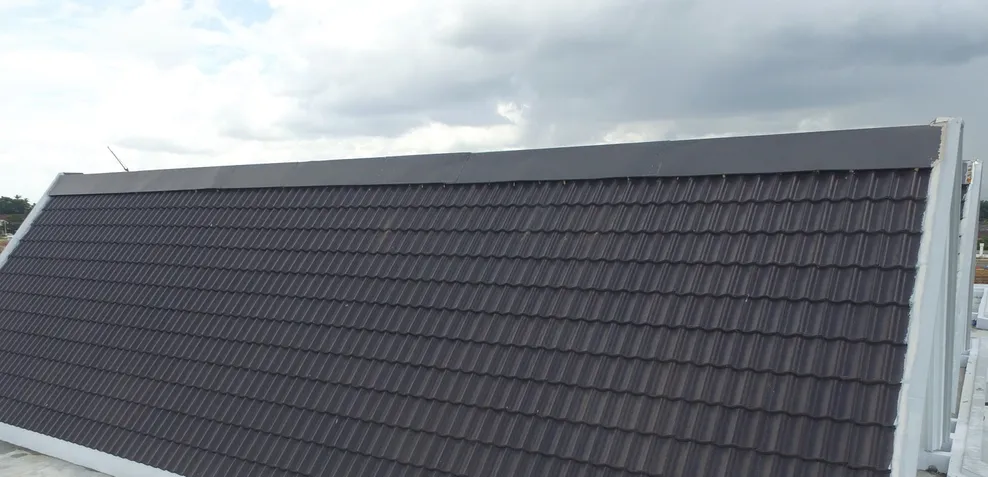
Roofing Carbon Footprint: Why Concrete and Clay Tiles Are the Greener Choice
Share:
Roofing Carbon Footprint Malaysia: Concrete and Clay Tiles vs Metal
Sustainability in construction is increasingly measured not by single-point metrics but by lifecycle environmental performance. For roofing materials, the relevant question is not which material has the lowest carbon footprint to manufacture, but which delivers the lowest total lifecycle carbon impact per year of service over the building's lifetime.
This article examines the carbon footprint of concrete, clay, and metal roofing materials and explains why, over a realistic Malaysian building lifespan, tile roofing delivers materially lower total lifecycle carbon than metal alternatives.
Understanding Lifecycle Carbon in Roofing
The lifecycle carbon of a roofing material encompasses three main phases. Embodied carbon refers to the emissions generated in raw material extraction, manufacturing, and transport of the product to site. Operational carbon refers to the indirect emissions associated with the energy performance of the building, where a thermally superior roof reduces air-conditioning energy consumption and therefore the electricity-related carbon footprint of the home. End-of-life carbon accounts for emissions from disposal or recycling at the product's end of service.
Roofing materials differ significantly across all three phases, and the relative importance of each phase changes with service life. For a material that lasts 100 years, the embodied carbon of manufacturing is amortised over a very long period. For a material that requires replacement every 20 years, that embodied carbon is incurred again and again.
Embodied Carbon: Manufacturing Comparison
Steel production, which underpins metal roofing, is one of the most carbon-intensive industrial processes globally. The International Energy Agency estimates that the steel sector accounts for approximately 7 percent of global CO2 emissions. While recycled steel content reduces this figure, the preparation of steel coil and application of protective coatings for metal roofing remains energy-intensive.
Concrete tiles are manufactured primarily from cement, sand, and water. Cement production generates CO2 through the calcination of limestone, but the quantities per unit area of roof tile are modest, and the long service life of the tile amortises the embodied carbon over a period of 50 to 100 years. Clay tiles, fired from natural clay, have embodied carbon primarily from the kiln firing process. Both concrete and clay tiles are typically manufactured from locally or regionally sourced raw materials, minimising transport emissions.
Annual Lifecycle Carbon: The Decisive Metric
Published research comparing tile and metal roofing on an annual lifecycle carbon basis consistently shows that clay tiles produce substantially less carbon per year of service than steel roofing. Figures cited in sustainability assessments for comparable roofing products indicate annual lifecycle carbon for clay tiles of approximately 0.50 kg CO2-equivalent per square metre per year, compared to approximately 3.28 kg CO2-equivalent per square metre per year for steel roofing.
This 6.5-times difference per year of service means that even accounting for the recyclability of steel at end of life, a 75 to 100-year tile roof generates significantly less total lifecycle carbon than metal roofing replaced multiple times over the same period.
Recyclability: Understanding the Metal Claim
Metal roofing proponents frequently cite 100 percent recyclability as a sustainability advantage. This is true in principle: steel is recyclable. However, the sustainability value of recyclability depends on whether the material is actually recycled at end of life, what the carbon cost of recycling is, and how the recyclability figure is calculated relative to the full lifecycle.
In Malaysia's recycling infrastructure environment, not all removed roofing steel is recovered and processed through formal recycling streams. Some proportion enters general waste disposal. Additionally, the recycling of steel still requires energy-intensive processing. The net carbon credit from metal roofing recyclability, while real, does not reverse the annual lifecycle carbon disadvantage relative to tile roofing over a full 30 to 100-year comparison period.
Green Building Certification: How Tile Roofing Contributes
Malaysia's Green Building Index (GBI), administered by the Green Building Index Sdn Bhd, awards credits for energy performance, materials, and resources under its rating systems for residential and non-residential buildings. Tile roofing can contribute to GBI credits in multiple categories.
The thermal mass of concrete and clay tiles contributes to building energy performance credits by demonstrating reduced cooling load relative to metal alternatives. This can be supported with thermal simulation using recognised software tools. Material credits can be claimed for tiles produced from locally sourced or recycled-content materials. Where Environmental Product Declarations (EPDs) are available for specified tile products, these can support materials transparency credits.
The Sustainability Case in Summary
• Tile roofing generates approximately 6.5 times less carbon per year of service than steel roofing, on a lifecycle basis.
• Concrete and clay tiles are typically manufactured from locally sourced materials, reducing transport emissions.
• Long tile service life (50 to 100 years) amortises embodied manufacturing carbon over far more years than metal roofing, which requires periodic replacement.
• Metal recyclability is a real but partial credit that does not reverse the annual carbon disadvantage over a full building lifecycle.
• Tile roofing supports Malaysian GBI certification through energy performance, thermal comfort, and materials sourcing credits.