Our countries


Europe
 Austria | Österreich
 Belgium | BelgiqueBelgium | België
 Bulgaria | България
 Croatia | Hrvatska
 Czechia | Česko
 Denmark | Danmark
 Estonia | Eesti
 Finland | Suomi
 France
 Germany | Deutschland
 Hungary | Magyarország
 Ireland | Éire
 Italy | Italia
 Latvia | Latvija
 Lithuania | Lietuva
 Netherlands | Nederland
 Norway | Norge
 Poland | Polska
 Portugal
 Romania | România
 Slovakia | Slovensko
 Slovenia | Slovenija
 Spain | España
 Sweden | Sverige
 Switzerland | SchweizSwitzerland | Suisse
 Turkey | Türkiye
 United Kingdom
Search
Heat Retention Compared: Metal vs Concrete Roof in Malaysia's Climate
Share:
Metal vs Concrete Roof Heat Retention in Malaysia
In Malaysia's tropical climate, the thermal performance of a roof is directly linked to the comfort of everyone living beneath it and the electricity cost of maintaining that comfort. Heat gain through the roof is the single largest driver of air-conditioning load in Malaysian homes, and the choice of roofing material determines how much of the sun's energy enters the living space.
This article compares the heat retention characteristics of metal and concrete tile roofing using measurable thermal properties and published research relevant to Malaysian conditions.
Key Thermal Properties: What They Mean
Thermal Mass
Thermal mass is the ability of a material to absorb, store, and slowly release heat. High-thermal-mass materials absorb solar energy during the day and release it gradually after sunset, buffering the interior from peak daytime temperatures. Concrete and clay are classic high-thermal-mass building materials. Metal has very low thermal mass.
Solar Reflectance Index (SRI)
SRI measures how effectively a material reflects solar radiation. A white surface reflecting nearly all solar energy scores approximately 100. A dark surface absorbing nearly all solar energy scores approximately 0. Metal roofing with light-coloured factory coatings achieves relatively high SRI values, which reduces direct solar heat absorption.
However, SRI alone does not determine comfort inside the building, because reflected heat does not enter the structure but radiated heat from the roof element still warms the air space below.
U-Value
U-value measures the rate at which heat is transmitted through a building element. A lower U-value indicates better thermal insulation. For a complete roofing system including insulation layers, both metal and tile assemblies can achieve similar U-values, but the method and permanence differ significantly.
How Metal and Tile Roofing Handle Solar Heat
A metal roof in Malaysian conditions heats up rapidly when exposed to direct morning or afternoon sun, with surface temperatures reaching 60 to 70 degrees Celsius on a clear day. This heat is rapidly conducted through the thin metal sheet and radiated into the roof space below. Without insulation, the roof space beneath a metal roof becomes a heat reservoir that radiates heat downward into the occupied space throughout the afternoon and evening.
With insulation, the heat flow from the metal roof into the occupied space is reduced. However, the metal surface itself still reaches extreme temperatures, and heat accumulates in the insulation layer. The rate at which this heat dissipates overnight depends on insulation thickness and thermal properties.
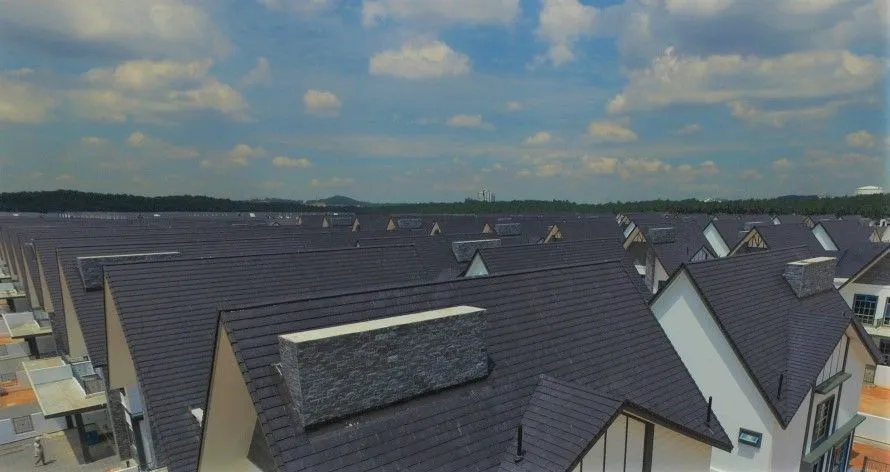
A concrete tile roof works differently. The tile absorbs solar energy, but its thermal mass means that the heat front travels slowly through the tile. In a typical concrete tile of 10 mm thickness, the peak heat absorbed at the outer surface at midday takes several hours to reach the inner surface. By the time this heat would reach the roof space, the exterior temperature has begun to drop, and the thermal gradient driving heat inward is reduced. Some of this stored heat is then released outward at night when ambient temperatures fall.
Research Data on Temperature Differences
University of Malaya research measuring indoor temperatures in simulated Malaysian terrace houses across different roof pitch angles provides a relevant quantitative reference. The study found indoor temperature ranges of 31 to 35 degrees Celsius under tropical conditions, with tile roofing contributing to a measurably lower internal temperature, particularly during the 12:00 to 16:00 peak solar radiation period.
The thermophysical advantage of tile over metal in equivalent applications translates to a reduction in cooling energy consumption estimated at 15 to 20 percent, representing a meaningful reduction in air-conditioning electricity usage over the building's life.
The Insulation Degradation Problem in Metal Roofing
Metal roofing achieves acceptable thermal performance in a new condition only when paired with adequate insulation. The challenge in Malaysia is that fibrous insulation materials, including glasswool, rockwool, and polyurethane foam, are all susceptible to moisture absorption in the country's 80 to 90 percent relative humidity environment.
Moisture-laden insulation loses a significant proportion of its effective thermal resistance (R-value). Oak Ridge National Laboratory research has demonstrated that the thermal conductivity of glasswool insulation increases substantially when moisture content rises above 1 percent by weight, with tropical climates capable of driving moisture content well above this threshold over time.
The practical consequence for Malaysian homeowners is that the thermal performance of an insulated metal roof at installation may degrade meaningfully within 10 to 15 years. A home that was acceptably cool after re-roofing becomes progressively hotter as insulation absorbs moisture, without any visible indication that this is occurring.
Pitch Angle and Orientation Effects on Heat Gain
Published research from the University of Malaya demonstrates that roof pitch angle has a measurable effect on indoor temperature in Malaysian terrace houses, with north or south-facing roofs at steeper pitches achieving the greatest reduction in heat gain. Specifically, a north-facing tile roof at 60-degree pitch achieves an indoor temperature approximately 1.5 degrees Celsius lower than a flat roof during the hottest period of the day. For east or west-facing roofs, steeper pitches actually increase heat gain slightly, making orientation an important design variable.
This research reinforces that the thermal performance of a roofing system in Malaysia is determined by a combination of material choice, pitch, and orientation, with tile roofing providing the thermal mass that benefits from these geometric variables in a way that thin metal cannot replicate.
Summary: Thermal Performance in Malaysia
- Concrete and clay roof tiles offer inherent thermal mass that helps moderate indoor temperatures during peak daytime heat.
- Unlike lightweight metal roofing, tile roofing does not depend solely on insulation layers to support thermal comfort performance.
- The durability of tile roofing allows thermal performance benefits to remain consistent over decades of service life.
- In Malaysia’s hot and humid climate, tile roofing can contribute to improved indoor comfort and reduced reliance on air-conditioning.