Our country pages


Europe
 Austria | Österreich
 Belgium | BelgiqueBelgium | België
 Bulgaria | България
 Croatia | Hrvatska
 Czechia | Česko
 Denmark | Danmark
 Estonia | Eesti
 Finland | Suomi
 France
 Germany | Deutschland
 Hungary | Magyarország
 Ireland | Éire
 Italy | Italia
 Latvia | Latvija
 Lithuania | Lietuva
 Netherlands | Nederland
 Norway | Norge
 Poland | Polska
 Portugal
 Romania | România
 Slovakia | Slovensko
 Slovenia | Slovenija
 Spain | España
 Sweden | Sverige
 Switzerland | SchweizSwitzerland | Suisse
 Turkey | Türkiye
 United Kingdom
Search
Eco-Hôtel Spa Yves Rocher: sustainable building

A green roof for the Eco-Hôtel Spa Yves Rocher
A place where you feel good and which does good to nature
The Eco-Hôtel Spa Yves Rocher nestles among the green countryside at the entrance to La Gacilly, a village set at the edge of the river Aff in the French département of Morbihan. This is the birthplace of Yves Rocher who, from early childhood, was passionate about the plant world. At the end of the 1950s, he created his brand in La Gacilly and developed his company based on the visionary concept of plant-based care and beauty products. Creator of the Cosmétique Végétale® brand, he cultivated his own plants locally and developed an ecosystem with a botanical garden, the “Vegetarium” restaurant, and later, the Yves Rocher Foundation, which works to protect nature and the environment.
The inspiration behind the 4-star Eco-Hôtel Spa draws on the history and values of the Yves Rocher family business which has always been committed to plants, to the region and to its visitors and customers. This is the first ever sustainable HQE building created for the hotel industry.
Jump to section
The challenge
Everything must be focused on the environment and the quality of life
The idea behind the “La Grée des Landes” building project (a 4-star spa hotel devoted to personal care and beauty) was to promote protection of the environment and biodiversity without adversely affecting the building’s aesthetics, and while promoting well-being and the quality of life of its occupants.
It was the proposal of the architectural firm, Hubert Pénicaud, a specialist in sustainable buildings, that was selected for implementation. In their design, the building takes the exact shape of the sloping land so that it blends harmoniously into the landscape, offering each bedroom a view out over the surrounding countryside. Nothing would be left to chance in creating this low energy building and turning it into an ambassador of the brand inspired by plants. What’s more, as the hotel’s inauguration was due to take place in the spring in time for the tourist season, compliance with deadlines was essential at this complex site where the hotel industry’s first ever HQE building was to be created.
The solution: a sustainable building with a green roof
Responsible management
Participatory planning encourages intense interaction between everyone involved in the final product. Nothing is left to chance; the choice of materials and implementation methods are agreed upon jointly, always as part of a comprehensive approach. “Every proposal needed to be elaborated on (…), there was a lot of discussion from a technical point of view to find the best solutions”, recalls Denis Vaillant, CEO of O.Hervieux, a waterproofing company that has been operating in the area for 40 years.
A green roof: multiple benefits
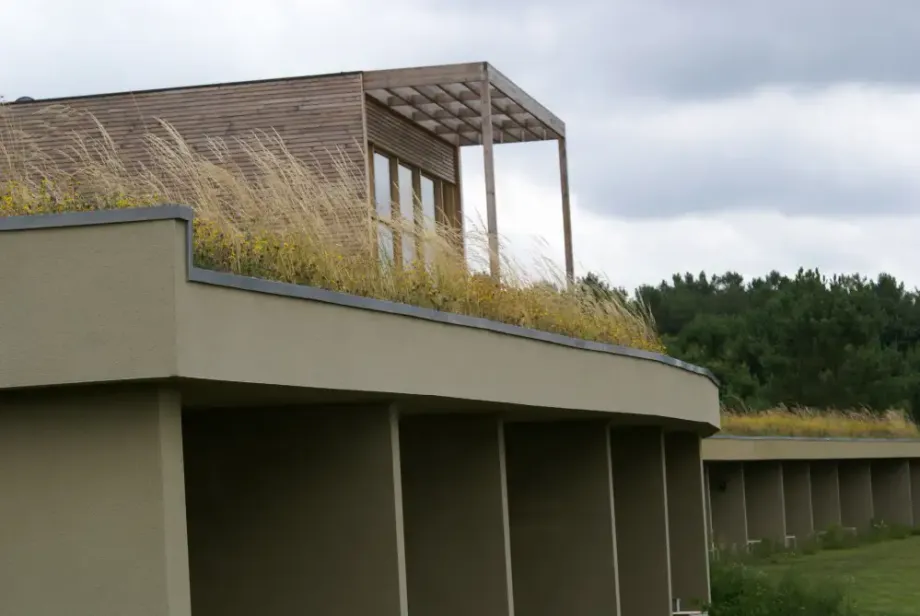
The highlight of the project – the roof garden – offers the sustainable building numerous benefits. The roof garden and its ecosystem evolve with the changing seasons, taking on different shades and hues as its wild plants are tossed about by the wind.
The roof garden plays its part in the fight against global warming by reducing the building’s energy expenditure and therefore its greenhouse gas emissions.
A green roof also promotes health and well-being; nature takes care of you by reducing air pollution as well as visual, olfactory and noise pollution. Its benefits are multiple and come together naturally: “With a 300-mm deep layer of topsoil on top of the insulation, the roof garden facilitates thermal inertia and provides the acoustic absorption that we require,” adds the Technical Director of Yves Rocher. Indeed, an attenuation of 30 dB was measured in the bedrooms.
The vegetation also protects the roof’s watertightness as Denis Vaillant points out. “In the end we opted for an inverted roof because we wanted to reduce the parapets to gain 40 cm and have a better view of the surrounding countryside”, he underlines. For the spa’s roof garden, which is barely visible, a self-protected waterproofing system made of slate chippings was chosen to match the restaurant’s sloping zinc roofs.
High-performance ecological materials
The materials were carefully selected to meet the sustainable building’s specifications and optimize the building’s performance (the spa’s timber frame is built with untreated Douglas fir while that of the building housing the restaurant and reception is made of aerated concrete).
An HQE building
This ambitious low energy building project has been designed to reduce energy consumption to a maximum. This is achieved by the orientation of the building and the use of efficient materials and renewable energy installations.
The result
“La Grée des Landes” also has a spa complete with an eternity pool, a steam room and care treatments. Its gastronomic restaurant offers seasonal dishes made with organic products grown by local farmers or hand-picked from the hotel’s vegetable garden. Yves Rocher’s philosophy continues to exert its influence over the region, and “La Grée des Landes” is a premium destination out in the countryside where you can relax and take a break or work in the peaceful surroundings.
BMI, so much more than a roof
Alongside the contracting authorities and general contractors who build the sustainable buildings of the future, BMI provides solutions designed for buildings that take care of nature as well as people. We are constantly innovating to provide high-performance waterproofing systems which often go beyond regulatory requirements.
A BMI roof is so much more than a roof. The roof garden of “La Grée des Landes” promotes nature and biodiversity, improves air quality, enhances the building’s visual appearance and acoustic properties, contributes to its thermal insulation and helps to ensure comfort in the winter and summer, etc.
Our group continues to innovate to support you in respecting the new 2020 environmental regulation (RT2020) and to help you build positive energy buildings which protect our environment and reinvent a quality of life where future generations can thrive.
Project Highlights
Project Highlights
- Contracting authority: Yves Rocher
- Architectural firm: Hubert Pénicaud
- Supervisory office: Socotec
- Waterproofing company: O. Hervieux
- BMI Siplast products:
- Preflex, Graviflex, Canopia drain, Canopia filter and topsoil for the roof garden (1,100 m2)
- Paradiene SR3 and Paracier roof membrane for the spa (200 m2)