Our countries


Europe
 Austria | Österreich
 Belgium | BelgiqueBelgium | België
 Bulgaria | България
 Croatia | Hrvatska
 Czechia | Česko
 Denmark | Danmark
 Estonia | Eesti
 Finland | Suomi
 France
 Germany | Deutschland
 Hungary | Magyarország
 Ireland | Éire
 Italy | Italia
 Latvia | Latvija
 Lithuania | Lietuva
 Netherlands | Nederland
 Norway | Norge
 Poland | Polska
 Portugal
 Romania | România
 Slovakia | Slovensko
 Slovenia | Slovenija
 Spain | España
 Sweden | Sverige
 Switzerland | SchweizSwitzerland | Suisse
 Turkey | Türkiye
 United Kingdom
Search
Roof Ridge Cap Tiles: Functions, Types, and Benefits for Your Roof
Share:
Roof Ridge Cap Tiles: Functions, Types, and Benefit
The ridge of a pitched roof is its highest and most exposed point. Where two roof slopes meet at the apex, the junction must be sealed against rain, wind, and pest entry without restricting the air circulation that keeps a roof space healthy. Ridge cap tiles perform this function, and their correct specification and installation determine the long-term performance of an otherwise well-built roof.
What Are Ridge Cap Tiles?
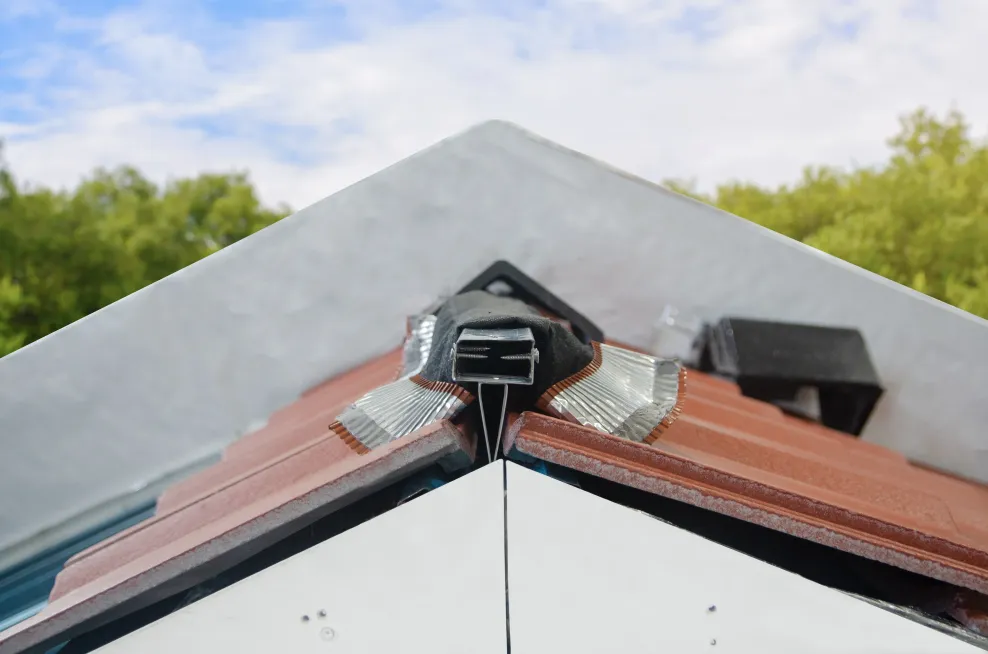
Ridge cap tiles are purpose-made roofing elements installed along the apex where two opposing slopes converge. Unlike field tiles, which are flat or gently profiled to interlock across the main roof area, ridge caps are formed with a curved or angular profile that sits over the ridge board and overlaps the top course of field tiles on each slope, creating a weathertight coping across the full length of the ridge.
In Malaysia's residential roofing market, concrete ridge caps matched to specific tile profiles are the standard for pitched roofs. Clay ridge tiles are commonly specified for heritage buildings, mosques, and premium residential projects where the warmth and authenticity of fired clay is part of the design intent.
Functions of Ridge Cap Tiles
Weatherproofing at the Most Vulnerable Junction
The ridge receives rain from both sides of the roof simultaneously during storms. A correctly designed ridge cap system with adequate overlap and secure fixings prevents any wind-driven rain from penetrating the junction, directing all water down the field tile surface and into the eaves guttering.
Wind Load Resistance
Ridge caps are subject to the highest wind uplift forces on any roof. Their position at the apex means they experience the full aerodynamic effect of wind flowing over the roof surface. Ridge cap fixings must be designed and specified to resist the wind loads applicable to the project location. In Malaysia, wind loads are governed by and the requirements of Uniform Building By-Laws (UBBL).
Ventilation Management
Tile ridges need to allow moisture-laden air from the roof space to exhaust at the apex while preventing rain ingress. Some ridge systems incorporate ventilation functionality, with perforated or slotted components that maintain airflow without creating a path for water entry. This is particularly relevant in Malaysia where roof space ventilation prevents condensation and the structural degradation of timber elements caused by sustained moisture.
Pest Exclusion
An incompletely sealed ridge is an access point for birds, bats, rodents, and insects. Pest infestation of roof spaces is a documented problem in Malaysian properties, with consequences including structural damage from nesting, fire risk from chewed wiring, and health concerns from accumulated droppings. Ridge caps, when installed with appropriate closure pieces and correctly bedded or clipped, form a continuous barrier against pest entry.
Dry-Fix vs Wet-Fix Ridge Systems
The choice between dry-fix and mortar-bedded (wet-fix) ridge installation is one of the most significant decisions in ridge cap specification. The following comparison is relevant to the Malaysian climate.
Factor | Dry-Fix System vs Wet-Fix (Mortar) System |
|---|---|
Weather Resistance | Dry-fix: Mechanical clip fixings remain secure through thermal cycling. Wet-fix: Mortar cracks under tropical thermal stress within 5-15 years. |
Maintenance | Dry-fix: Minimal. Dry-fix components are designed for the tile's full service life. Wet-fix: Periodic repointing typically required every 10-15 years. |
Wind Performance | Dry-fix: Tested and rated wind uplift resistance per BS 5534. Wet-fix: Mortar bond strength degrades and becomes unpredictable over time. |
Installation Speed | Dry-fix: Faster, no curing time required. Wet-fix: Requires mortar mixing and curing time before full strength is achieved. |
Aesthetics | Dry-fix: Clean, consistent line. Wet-fix: Mortar staining and cracking becomes visible as weathering progresses. |
Long-Term Cost | Dry-fix: Higher initial cost, significantly lower maintenance cost. Wet-fix: Lower initial cost, repeated repointing adds lifecycle cost. |
For new construction and roof renovation in Malaysia, dry-fix ridge systems aligned with the tile manufacturer's system range are strongly preferred from both a performance and maintenance standpoint. The initial cost premium is recovered within the first repointing cycle of a mortar system.
MONIER® Ridge Cap Tile Range
MONIER® manufactures ridge cap tiles matched to each profile in its concrete and clay tile range. The dimensional relationship between a field tile profile and its corresponding ridge cap is precision-engineered to ensure a correct overlap and seal. Using off-specification or generic ridge tiles with MONIER® field tiles creates dimensional mismatches that compromise the weathertight performance of the junction.
MONIER® dry-fix ridge system uses mechanical clips secured to the ridge board, with a flexible sealing compound that accommodates thermal movement without cracking. The system is tested and validated for the wind uplift conditions applicable to Malaysian low-rise residential construction.
Installation Considerations
Correct ridge cap installation requires accurate setting out of the first batten distance from the eaves, working up to the ridge so that the top course of field tiles and the ridge cap overlap correctly. The ridge tile mortar or fixing clip must be positioned to maintain a consistent ridge line. Ridge ends require closure tiles or purpose-made hip-ridge intersection tiles that complete the detail at the hip junction.
These are specialist operations that require experience and knowledge of the specific tile system. MONIER® RoofPro certification programme trains contractors in the correct installation sequence for its ridge and hip components, ensuring that the finished detail meets the performance specification.